1. Introduction: When One Phone Becomes a Customer Service Battlefield
At the start, one WhatsApp number feels enough. You reply to every message, customers are happy, and life is simple. But the moment your brand starts growing, that same phone becomes a non-stop buzzing machine. New leads, order queries, delivery questions, follow-ups… all coming at once.
Now imagine this: you reply to one customer, three more messages arrive. You check Instagram, five WhatsApp chats are waiting. You go for lunch, and by the time you come back, you have 47 unread messages. Not because customers are impatient, but because business is finally working.
This is the stage where many growing brands either scale smartly or start losing customers quietly. The problem is not demand. The problem is managing conversations at scale, on one single WhatsApp number.
2. The Real Problem: One Inbox, Too Many Conversations
What usually goes wrong
Most brands handle WhatsApp like personal chat, even when business is no longer personal-size.
Common issues:
Messages get buried under new chats
Customers repeat the same question again and again
Team members use the same phone and confuse conversations
Important leads are forgotten completely
And the worst part? Customers think you are ignoring them, even when you are just overloaded.
Funny but painful reality
You might have seen this:
Customer: “Hi, is this available?”
You (after 3 hours): “Yes, available.”
Customer: “Okay, I already ordered from somewhere else.”
No anger. No complaint. Just lost business.
This is not because your product is bad. It is because response speed is now part of customer experience. And personal WhatsApp simply was not built for business scale.
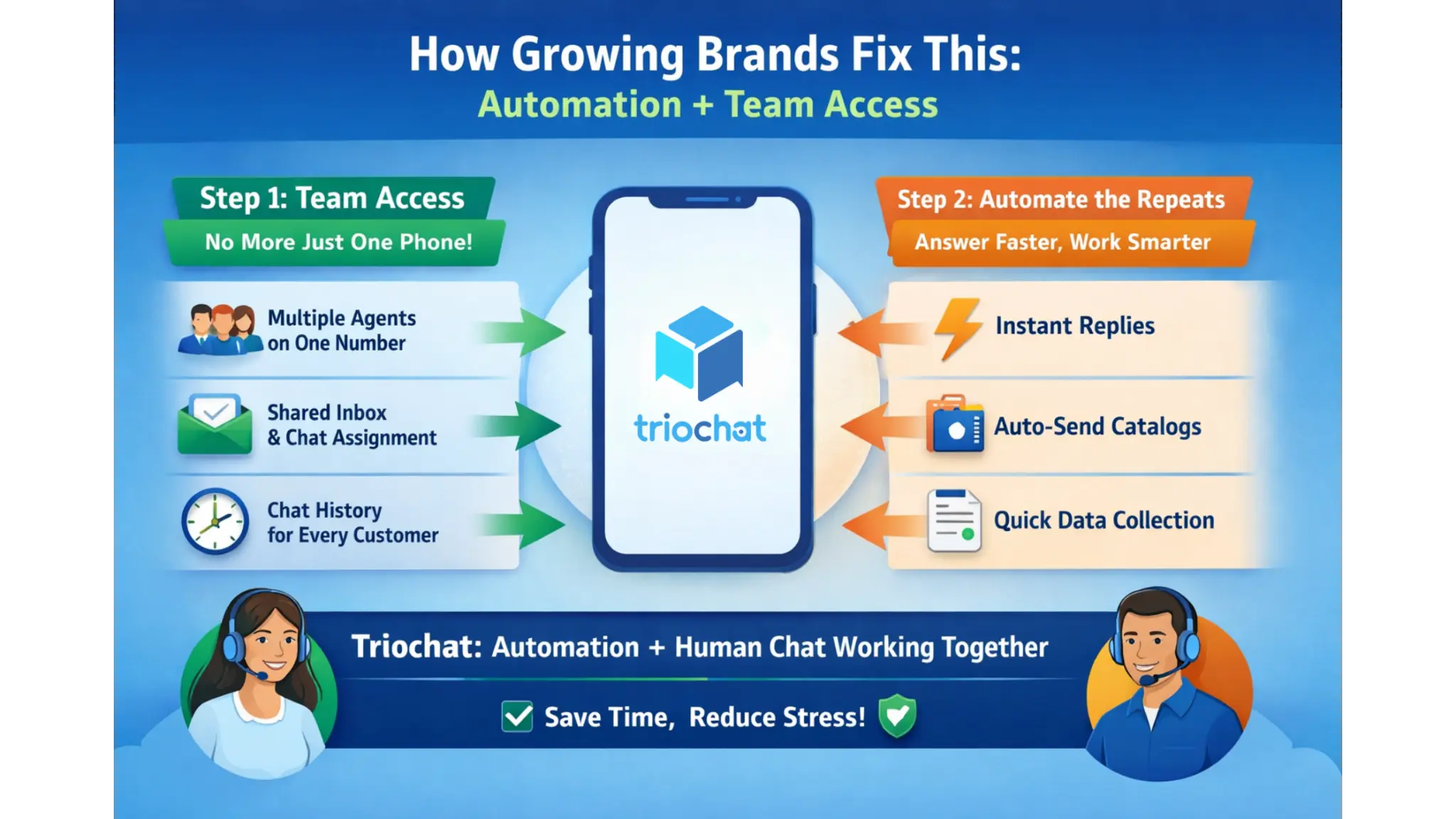
3. How Growing Brands Fix This: Automation + Team Access
Step one: stop depending on one phone
Growing brands move their WhatsApp to platforms that allow:
Multiple team members on one number
Shared inbox with clear chat assignment
Conversation history for every customer
This way, sales, support, and operations do not fight over one phone.
Step two: automate the boring stuff
Let us be honest.
Most customer questions are repeated:
Price?
Delivery time?
Location?
Product details?
Instead of typing the same replies 100 times, brands use automation to:
Send instant replies
Share catalogs automatically
Collect basic details before human reply
This is where tools like triochat.io step in. It connects your WhatsApp to smart automation while still allowing human conversations when needed. Customers get fast replies, and your team saves hours every day.
Automation does not replace people. It protects them from burnout.
4. Managing 1,000 Customers Without Sounding Like a Robot
Personal feel is still important
One fear brands have is:
“If we automate, will customers feel ignored?”
Actually, good automation does the opposite. It:
Greets instantly
Uses customer name
Routes chat to right department
So the customer does not wait, and your team replies with full context instead of asking “Can you explain again?”
Real life example
Imagine ordering food and getting:
“Please wait, we will reply.”
Versus:
“Hi Rahul, thanks for messaging us. For order status, tap 1. For product help, tap 2.”
Which one feels more professional?
With triochat.io, brands design flows where customers move quickly to the right solution instead of waiting in a long message queue. Less frustration, more conversions.
Because nobody enjoys being left on “seen”.
5. Turning WhatsApp Into a Sales and Support Machine
It is not just about replying
Smart brands do more than answer messages. They use WhatsApp to:
Send order updates
Follow up on abandoned leads
Run broadcast campaigns
Collect feedback after delivery
All from the same number, without spamming or getting blocked.
Why WhatsApp works so well
Messages are opened almost instantly
Customers already trust the platform
No extra app download needed
With triochat.io WhatsApp automation, brands track conversations, schedule campaigns, and make sure no lead is forgotten. Instead of chasing customers, they stay connected naturally through chat.
Basically, WhatsApp becomes your sales desk, help desk, and marketing channel in one place.
6. Conclusion: Can Your Brand Handle Growth on One Phone?
Every growing brand reaches this moment.
When messages increase, customers expect faster replies, and one WhatsApp number feels impossible to manage.
You can either:
Keep struggling with missed chats and lost orders
Or upgrade the way you handle conversations
The brands that scale smoothly are not working harder. They are working smarter with tools that fit their growth stage.
So the real question is not:
“Do we need WhatsApp automation?”
The real question is:
How many customers are you ready to lose before you fix it?
If your business is serious about growth, it might be time to let triochat.io handle the chaos while your team focuses on closing sales and building relationships.
Because one WhatsApp number can handle 1,000 customers.
But only if it is backed by the right system.