Introduction: When Automation Forgets the “Human” Part
Imagine you text a business, “Hi, I need help with my order,” and you instantly get:
“Press 1 for sales. Press 2 for support. Press 3 to repeat this menu.”
Congrats, you are now talking to a vending machine with WiFi.
WhatsApp automation is meant to make conversations faster and easier, not colder and more annoying. But many businesses set it up in a rush, focusing only on speed and scale, and they forget that customers are still people, not ticket numbers.
The result? Messages that feel robotic, confusing, or straight-up irritating. In this blog, we will break down the most common WhatsApp automation mistakes that kill trust, hurt conversions, and make brands sound like bots. More importantly, we will also see how tools like triochat.io help you automate without losing your human touch.
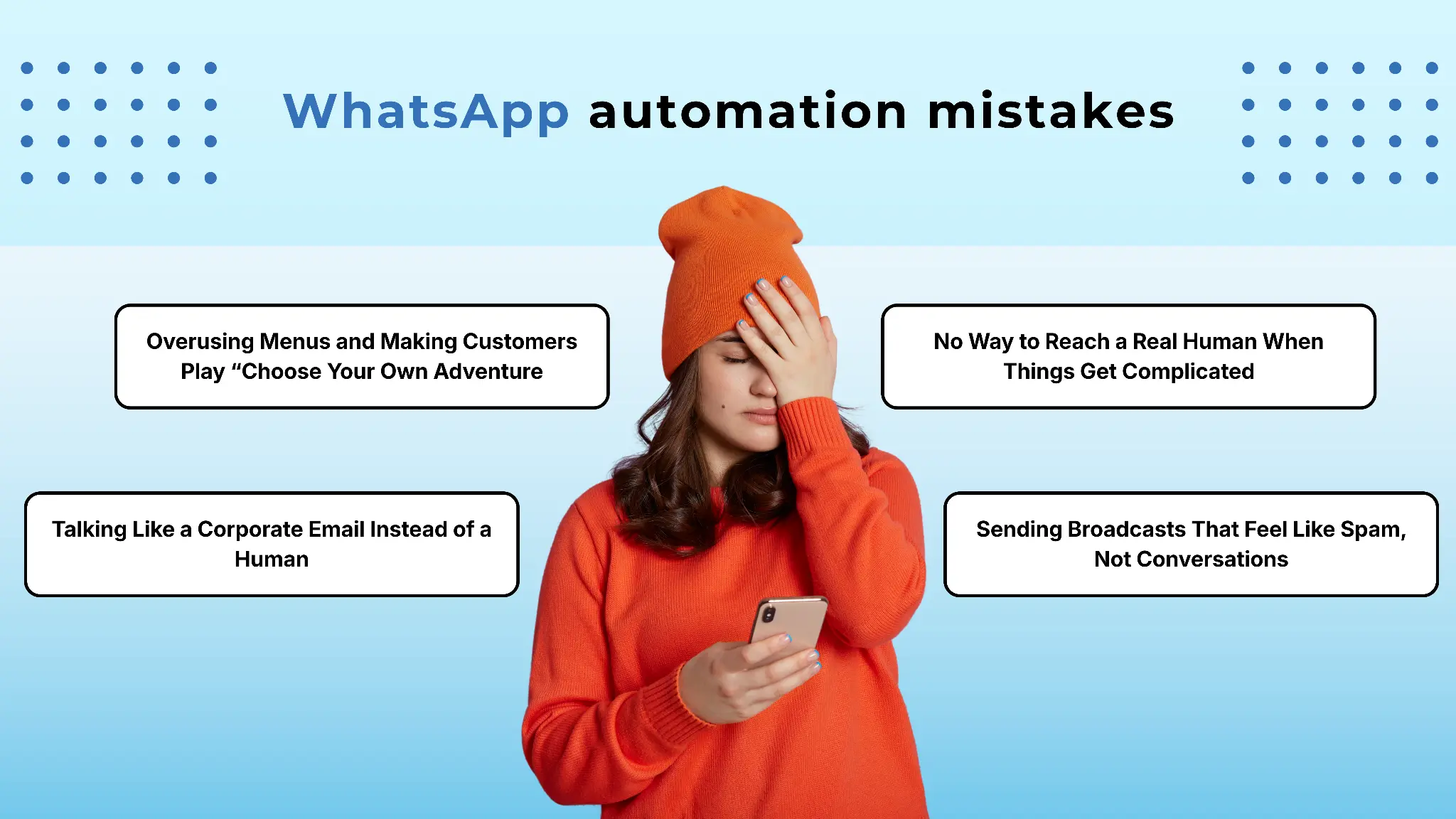
Mistake #1: Overusing Menus and Making Customers Play “Choose Your Own Adventure”
Long menus look organized on paper, but in real life they feel like a maze. Customers come to WhatsApp for quick answers, not to solve puzzles.
When every reply leads to another menu, users get tired and leave. Worse, they might message your competitor who replies with an actual sentence.
Why this happens
Many businesses think more options mean better service. But too many options create friction and delay, which is the opposite of what messaging apps are for.
What this looks like in real life
Customer: “Is this product in stock?”
Bot: “Press 1 for sales, 2 for support, 3 for billing.”
Customer: already regretting the message
How to fix it with smarter automation
Instead of forcing everyone into the same menu, automation should guide, not block.
Do this instead:
- Use intent-based replies that understand keywords like “price”, “stock”, or “delivery”
- Keep first-level menus short and meaningful
- Offer a quick human handoff option
- Show only relevant options based on the user’s question
With triochat.io’s smart flow builder, you can design conversations that feel natural and reduce unnecessary clicks. The system can route users based on what they actually ask, not just what you want to show them.
Mistake #2: Talking Like a Corporate Email Instead of a Human
If your WhatsApp messages sound like legal documents, you are doing it wrong.
People use WhatsApp to chat with friends, not to read policy statements. When automation messages feel too formal or stiff, users instantly know they are talking to a bot.
Signs your bot sounds robotic
- Using long, formal sentences
- Zero emotions or friendly tone
- No personalization at all
- Repeating the same fixed replies to everyone
Why this hurts your brand
Customers judge your brand by how you talk. If your tone feels cold, your brand feels distant. And distant brands do not build loyalty.
How to make automation sound human
You do not need jokes in every message, but you do need warmth and clarity.
Simple fixes that work:
- Use conversational language instead of corporate wording
- Add the customer’s name where possible
- Keep messages short and clear
- Acknowledge the customer’s question before answering
For example, instead of:
“Your request has been received. Please wait.”
Try:
“Got it, checking this for you right now ”
With triochat.io, you can personalize messages using dynamic variables and design friendly response templates that still stay professional. Automation should save time, not kill personality.
Mistake #3: No Way to Reach a Real Human When Things Get Complicated
Automation is great for FAQs, order tracking, and basic queries. But not every problem fits into a flowchart.
When customers are stuck in bot loops with no escape, frustration rises fast. And frustrated customers do not buy again.
Situations where bots alone are not enough
- Payment issues
- Delivery complaints
- Refund requests
- Technical problems
If your automation does not offer human support at the right moment, it becomes a wall instead of a bridge.
What customers expect today
People are fine with bots, as long as they know help is available when needed. The problem is not automation. The problem is automation without backup.
How to balance automation and human support
The best systems combine speed with flexibility.
Your automation should:
- Detect repeated failed interactions
- Offer “Talk to an agent” options
- Transfer chat history to the human agent
- Resume automation after human support if needed
triochat.io supports automation plus live agent handoff in one platform, so customers do not have to repeat their problem again and again. This makes conversations smoother and keeps your brand feeling responsive, not robotic.
Mistake #4: Sending Broadcasts That Feel Like Spam, Not Conversations
Broadcast messages are powerful, but only if they feel relevant and timely. When businesses blast the same message to everyone, customers stop reading or worse, they block you.
Nothing says “robot marketing” like messages that ignore who the customer is or what they care about.
Common broadcast mistakes
- Same offer sent to all users
- No segmentation
- No reference to past activity
- Too many messages in short time
At this point, your WhatsApp becomes just another noisy ad channel.
What works better
People respond to messages that feel useful, not pushy.
Smarter broadcast strategies include:
- Segmenting users by interest or purchase history
- Sending reminders instead of random promotions
- Using soft CTAs instead of hard selling every time
- Testing message timing
With triochat.io’s CSV and Google Sheets campaign tools, you can easily segment and schedule personalized broadcasts that actually feel like updates, not spam. Automation should support relationships, not burn them.
Conclusion: Automation Should Feel Like Help, Not Like Homework
WhatsApp automation is not the problem. Bad automation is.
When flows are too rigid, language is too formal, support is unreachable, and broadcasts feel spammy, customers feel like they are talking to machines. And machines do not build trust, loyalty, or long-term sales.
The real goal of automation is simple:
Reply faster, guide smarter, and stay human.
That is where platforms like triochat.io make a real difference by combining smart automation, easy integrations, and live agent support in one clean system.
If your WhatsApp automation sounds more like a robot than a real brand, maybe it is time to rethink how your conversations are designed.
Because here is the real question you should be asking yourself:
Are your customers chatting with your brand… or just clicking through your scripts?
If you want your conversations to convert, not just respond, start building smarter flows with triochat.io today and stay tuned for our next blog where we break down how to design WhatsApp journeys that actually drive sales.
Explore pricing and features at triochat.io